Tuesday, February 24, 2015

My Conditions for Creativity


I’ve been an active and semi-professional photographer for several decades now.  But despite all that experience, I still struggle—as I’m sure most photographers do—with being creative and making images that are fresh and that reflect my own vision.  Recently, I read a book—The Photographer’s Coach (Kindle)—by Robin Whalley that outlines a series of exercises to help define the sources of one’s inspiration and vision.

An early exercise helped me identify times when I was most creative photographically, as well as those times when I’ve struggled to find my creative vision.  This resulted in a list of conditions when I’m most likely to be creative.

I’m more creative when I have a defined and adequate amount of time to devote to my photography.  I do poorly when I’m feeling rushed.  I need the time to see a particular scene from a variety of perspectives, perhaps using different lenses, because I find that although I may know at once when a scene attracts me, it may take a while to identify the exact perspective that best expresses what I saw in the scene in the first place.

I do best when my photographic goals are clear.  When my thinking is muddled, when I don’t have a firm concept of what I want to achieve, my confusion will be reflected in my images.  If I find myself straining to make good images, I rarely succeed.

I work best when I’m alone.  I find that when I’m with others, I’m overly conscious that they don’t share my photographic agenda and I tend to hold back from expressing myself creatively.  In those situations, I’m apt to produce snapshots, not creative photos.

It’s also important that I feel confident that what I’m doing is meaningful and appropriate.  When I feel out of place, when my self-assurance is lacking, I shrink from making good photos.  In those times, I tend to rush my work and do poorly. 

These conditions are mutually supportive.  In the end, having clear goals strengthens my assurance that I ought to be doing what I am in that moment.  This is easiest when I’ve allotted adequate time—be it an hour or a week—for the project at hand and have freed myself from distractions, either mental or interpersonal.

With greater clarity about the conditions under which I do my most creative work, I’m better prepared to create those conditions for myself when I go out shooting.  I’m eager to get out and put these ideas to the test.  If only I weren’t snowed in!

Tuesday, April 23, 2013

Building a Portfolio


I have lots of good photographs and have decided I'd like to sell them at art and craft shows.  But which of my photos should I try to sell?  I've got tens of thousands of photos I've taken over the years.  How do I winnow this collection down to a manageable size?  And what size should my portfolio b e in any event?

I've decided to settle on 20 as the size of my portfolio.  That means culling through my collection to find what I thin are the 20 most salable--if not necessarily the best--photographs.  My plan is to print these 20 in two sizes--8 1/2 X 11 and 11 X 14--and offer 10 of them matted and framed.  The remaining 10 I'll offer matted or unmatted so there will be several price points for buyers.

But, how do I get from tens of thousands down to 20 photos?  Here are the criteria I'm using to select them:

  • The best photos taken locally in the area where I live and will be selling
  • A few animal shots
  • A few good railroad photos
  • Some Civil War photos, since I live in Virginia, a site of much Civil War activity
  • Some landscape and nature photos
A Civil War cannon at the Bull Run battlefield, with a caption
 My emphasis is on the pictorial--things people would like to frame and hang on their walls.  The problem is, that's always a guessing game until you see what people actually like and buy.  So, I expect the first few shows to be an opportunity to see what the public likes, versus what I think they ought to like.


Another Bull Run cannon, without caption
One issue--I sign some of my photos with a caption in script at the bottom and some I leave plain without such an annotation.  Which should I do?  Are the captions helpful or a turnoff?  What do you think?  Leave me your comments.  I'll value your ideas.

Sunday, September 2, 2012

Serendipity Can Be Your Photo Friend


Sometimes photography depends on serendipity.  Oh, you can plan what you are going to do and carefully prepare for the photos you want to take.  But then again, things may not turn out as you had planned.  And sometimes, that is a good thing.

Nikkor 40 mm. micro lens, f3.2, 1/1250 second, ISO 400, Nikon D2X handheld.
This photo of a sunflower blossom beginning to open is a case in point.  I mounted a 40 mm. macro lens on my Nikon D2X and set the exposure for f3.2 at 1/1250 second.  I wanted to focus on the blossom itself and lose the background sharpness.  And I wanted to minimize any unsharpness from camera shake.  What I didn't count on, though, is what turned out to be one of the best features of the photo.  You see, it was a warm, humid morning when I arrived at the vineyard to make photographs.  I had just left my cool house minutes before--the vineyard is nearby.  What I noticed as I began to shoot was a thin film of moisture that continually formed on my lens, softening the focus each time I tried to shoot.  I would wipe off the lens, take a photo, and wipe the lens again, trying to keep it clear of moisture.  Evidently, I missed the moisture when I took this image.  And that, I think, is what makes this picture especially interesting--the delicacy imparted by the soft focus that in this case was entirely unplanned.

What started as a mistake turned into one of my favorite photos.  It just goes to show, you need to be able to go with the flow and let your photography be whatever it will be.

Norm

Friday, February 17, 2012

Virginia Living

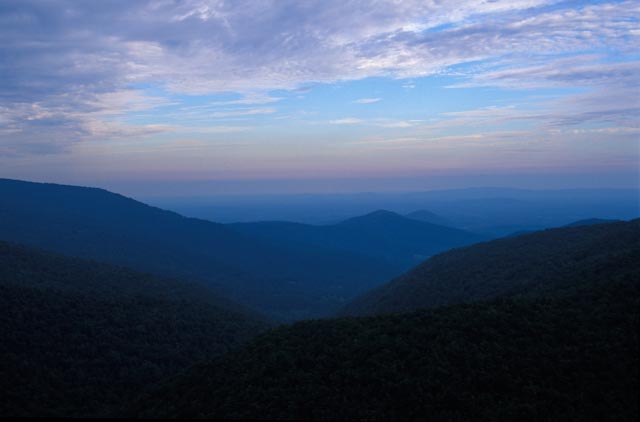
The Blue Ridge mountains at dusk.
Living in Virginia is wonderful for all the beauty one finds here.  And nowhere is more beautiful than the Blue Ridge country of the western part of the state.  Though much lower than the majestic peaks of the west, the Blue Ridge mountains nonetheless bear their own form of beauty and ruggedness.

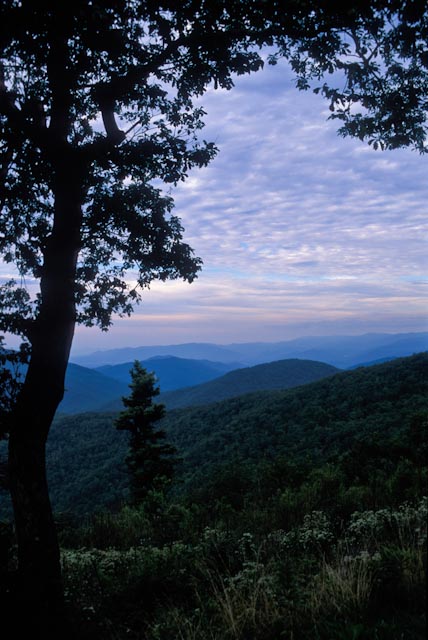
Layers of mountains cascade into the distance.
One finds here other attractions, such as the many waterfalls that are found along the Skyline Drive, which traverses the length of the Blue Ridge mountains and offers spectacular views of its scenery.

One of many charming waterfalls along the Skyline Drive.
The Shenandoah Valley, which lies between ranges of the Blue Ridge mountains, is a place of both beauty and agricultural productiveness.  This serene place is a highly sought-after place to live.
A corn field spreads out across the Shenandoah Valley at the foot of Massanutten Mountain
A lovely place to visit, I consider myself lucky to live so close to the Blue Ridge mountains and Shenandoah Valley, just a few miles away.

A view from Skyline Drive.

Wednesday, February 15, 2012

The Battle of New Market

A small Union soldier bears his country's flag.
Several years ago, I attended the re-enactment of the Civil War Battle of New Market in New Market, Virginia.  I had not witnessed a re-enactment before.   But as a Civil War buff, it was something I could not miss.

Rebels and Yankees face off.
The first thing you see on arriving are the civilian activities, couples sitting for period portraits, sutlers' tents selling everything Civil War, and modern-day vendor stands.

Firing the cannon.

But the real excitement was on the field of battle.  Before the fighting commenced, various contingents of cavalry passed my position.  Then some artillery units set up in front of me and put on repeated displays. 

A Union artillery crew at work.

Finally, there was the battle itself, which raged back and forth before being won, as it was in 1864, by the Confederates, aided by the schoolboys of the Virginia Military Academy (VMI).

Two Union cavalrymen.
Many re-enactments are taking place during this time of the sesquicentennial of one of the defining events of American history, the Civil War.  If you have a chance to take one in, I highly recommend it for both its historical interest and its photographic opportunities.
The Battle of New Market rages on.